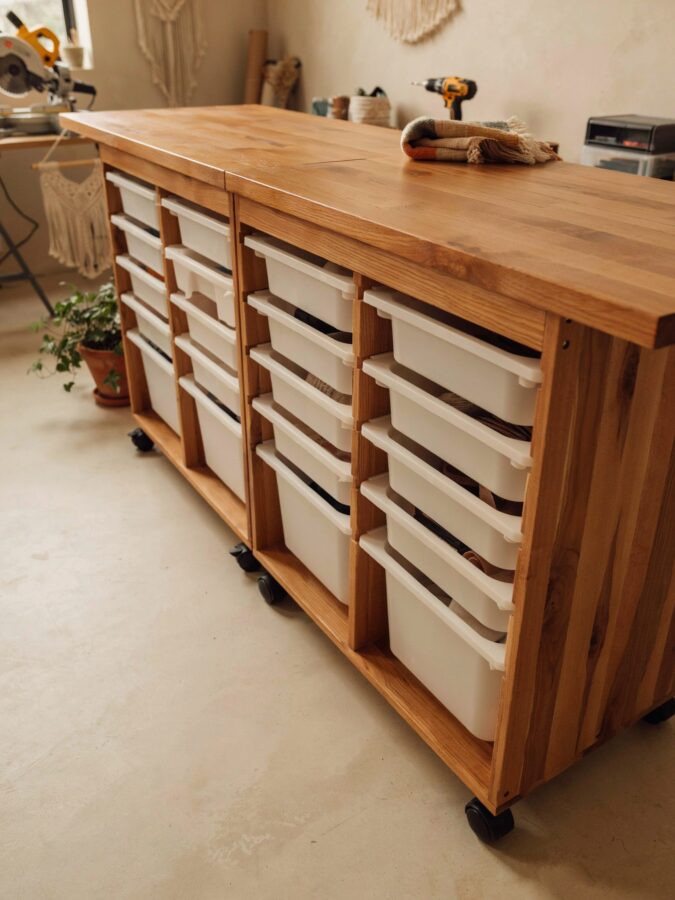
I have built my fair share of DIY rolling storage carts, and I will be the first to admit that my early attempts were wobbly disasters. If you want to build your own heavy duty shelf unit on wheels, this IKEA hack can save you a ton of money, but only if you avoid the common mistakes I made. This guide walks you through the pitfalls so you end up with a sturdy mobile shelf unit that actually holds up to workshop abuse, not a flimsy cart that tips over the first time you load it with tools.
Choosing the Wrong Plywood Thickness for Your IKEA Hack
The most common mistake I see is grabbing the thinnest plywood because it is cheap. A heavy duty rolling storage cart needs 3/4 inch plywood minimum, and for a really big unit I prefer 1 inch. Thin 1/2 inch boards will flex under the weight of casters and cause the whole structure to rack.
Go to the lumber yard and look for birch or oak plywood, not the soft pine stuff that splinters. I once used cheap underlayment plywood and the screw holes stripped out within three months. Spend a little extra on good material and your IKEA hack will last for years.
Ignoring Weight Distribution When Adding Casters
People slap casters on the bottom corners and call it done, but then the cart wobbles or the front lifts when they pull it. That happens because the weight is not centered over the wheels. For a rolling storage unit, you need to plan the caster placement so that the heaviest items sit directly above the wheel mounts.
- Calculate your load: Estimate what you will store power tools, hardware bins, heavy boxes and place the shelf heights accordingly.
- Use two locking casters: Put them on the same side so the cart stays put when you lean on it.
- Keep the casters inset: Mount them about 2 inches from the edge to reduce tipping leverage, but not so far in that the cart becomes unstable sideways.
If you build a tall unit with a narrow base, you will regret it the first time you try to roll it over a pebble. I learned that the hard way when my entire tool cart tipped and sent screwdrivers flying across the garage.
Using Inexpensive Swivel Casters That Fail Under Load
I bought a set of casters from a budget home store once. They were small plastic wheels rated for 50 pounds each. My cart weighed 40 pounds empty. Add a few boxes of nails and a drill, and the wheels shattered. For a heavy duty mobile shelf unit, you need at least 4 inch diameter casters with bearings and a load rating of at least 200 pounds each.
Look for polyurethane wheels, not hard plastic. They roll smoothly over concrete and small debris without cracking. Also make sure the mounting plate is thick steel, not thin stamped metal. A good set of casters costs about the same as a cheap set, but they will not fail after a few months of workshop abuse.
Skipping Corner Reinforcement in Your Woodworking Project
Plywood is strong along the face, but the edges are vulnerable. When you screw a side panel to a shelf, the joint relies on the plywood edge holding the screw threads. If you just butt join them with screws, the joint will loosen over time. This is where many DIY rolling storage cart builds fall apart.
Add corner braces or glue blocks. I use triangular 2×2 inch wood pieces in each corner, glued and screwed into both panels. It adds maybe 20 minutes to the build but transforms the strength. Another trick is to cut rabbets in the side panels so the shelves sit inside a groove. That locks everything together mechanically.
If you are following an IKEA hack tutorial, see if the original design uses connectors meant for particle board. Plywood screws hold better if you predrill and use coarse thread screws. Never just power a screw into plywood edge without a pilot hole.
Forgetting About Floor Clearance and Doorways
This is a mistake nobody warns you about. You build a big rolling shelf unit in your garage, and then you cannot roll it through the doorway or under a workbench. I once built a cart that was 30 inches wide and 40 inches tall, but my garage door frame was 32 inches. I had to disassemble it to move it.
Measure your path before you cut any wood. Include the height of the casters in your overall height. If you plan to store it under a shelf, leave at least 4 inches of clearance so you can reach into the bins. Also consider the turning radius if you are using locking casters on
#DIY #IKEAhack #rollingstorage #woodworkingproject #furniturebuilding
Leave a Comment